

Crew
Director – Jon M. Chu, Screenplay – Dana Fox & Winnie Holzman, Based on the Musical Wicked (2003) by Winnie Holzman & Stephen Schwartz, Based on the Novel Wicked: The Life and Times of the Wicked Witch of the West (1995) by Gregory Maguire, Producers – Marc Platt & David Stone, Photography – Alice Brooks, Music/Lyrics – Stephen Schwartz, Musical Score – John Powell & Stephen Schwartz, Visual Effects Supervisors – Jonathan Fawkner & Pablo Helman, Visual Effects/Animation – Industrial Light & Magic (Supervisors – Anthony Smith & Robert Weaver), Visual Effects – Framestore (Supervisor – Benjamin Magana), Special Effects Supervisor – Paul Corbould, Prosthetic Makeup Designer – Mark Coulier, Production Design – Nathan Crowley, Choreography – Christopher Scott. Production Company – Universal.
Cast
Cynthia Erivo (Elphaba Thropp), Ariana Grande-Butera (Galinda Upland/Glinda), Jonathan Bailey (Fiyero/The Scarecrow), Jeff Goldblum (The Wonderful Wizard of Oz), Michelle Yeoh (Madame Morrible), Marissa Bode (Nessarose Thropp), Ethan Slater (Boq/The Tin Man), Colman Domingo (Voice of the Cowardly Lion), Bowen Yang (Pfannee), Bronwen James (Shenshen)
Plot
After her rebellion against the Wizard, Elphaba has been branded the Wicked Witch of the West and is hunted by The Wizard’s guards. Meanwhile, Glinda announces her engagement to the guard Fiyero. Elphaba rejects the Wizard’s offer of peace. During the course of this, Fiyero comes to Elphaba’s aid. The two realise love for one another and he abandons Glinda for her. Glinda struggles to maintain her friendship with Elphaba despite this. Fiyero is beaten and Elphaba casts a spell to save his life, but this means transforming him into a scarecrow. Madame Morrible conjures a tornado as part of a plan to lure Elphaba so they can capture her. This transports a house from Kansas containing Dororthy Gale that lands on and kills Elphaba’s sister Nessarose. The Wizard persuades Dorothy and her companions – a lion that is terrified of Elphaba; the Fiyero transformed scarecrow; and the Tin Man, a munchkin transformed by a spell from Nessarose – to go to Elphaba’s domain and bring back her hat.
Wicked: For Good is the second half of the adaptation of the Musical Wicked (2003) from Stephen Schwartz, following Wicked: Part 1 (2024). This was in turn adapted from the novel Wicked: The Life and Times of the Wicked Witch of the West (1995) by Gregory Maguire and sets out to tell the backstory of The Wicked Witch of the West and Glinda the Good from The Wizard of Oz (1939).
I will freely admit that I wasn’t a fan of Wicked: Part 1. I’m not the intended audience for the film and am not a fan of musicals, although will happily write about any Wizard of Oz related content for the fantasy part of this site. I found Wicked: For Good a somewhat better film than the first, an opinion shared by some audiences. It is not as dominated by the first film’s excess, while the musical content is more suborned to the story the film wants to tell.
The production design doesn’t go to completely over-the-top like the first film did. It is still designed to impress the eye but doesn’t go overboard. The sole exception might be a train that is designed in Day Glo pink and looks for all the world like a stretch version of Lady Penelope’s Rolls out of tv’s Thunderbirds (1964-6). Although surely the image of Elphaba in effect skateboarding off on her in the opening scenes would have caused L. Frank Baum and the makers of the 1939 film to spin in their graves. There are times the production gives the impression of being rushed – the Cowardly Lion looks like a really obvious CGI effect.
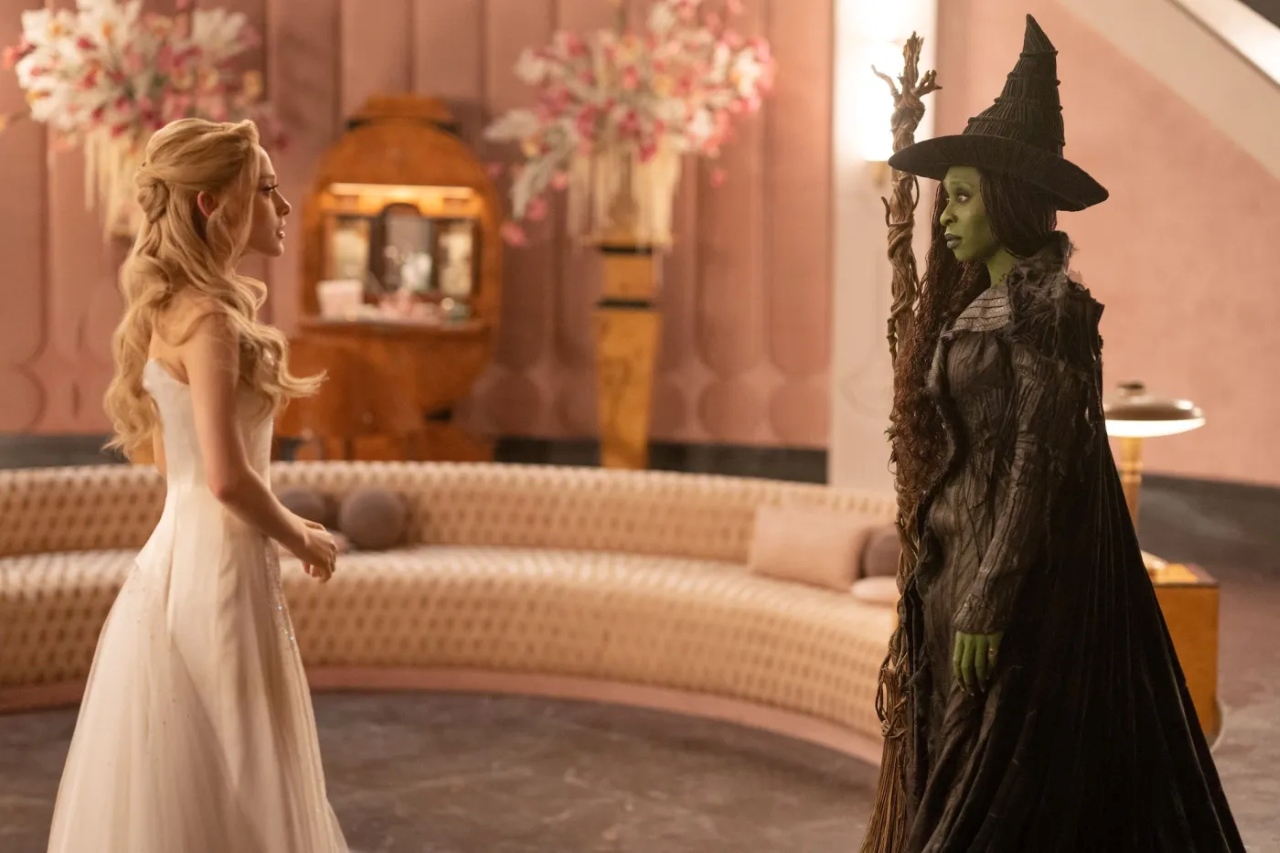
The problem here is in dragging the Wicked musical, which is customarily staged in a single evening, out to two films of two hours plus apiece, released a year apart. There feels like a lot of padding, even if the film is following the acts of the stage version fairly closely (albeit with the order of some scenes rearranged). The first hour of the film has not much happening other than a lot of “I miss you” vs “Can I trust you?” between Elphaba and Glinda, along with a romantic triangle that you feel should have struck more sparks than it does.
Mostly this section serves to connect up various pieces of fan services where we see the Yellow Brick Road being built; the creation of the red slippers (which we are told are now to try and make Elphaba’s wheelchair-ridden sister Nessarose walk); and the creation of the Tin Man and The Scarecrow. The latter half of the film gives us the arrival of the tornado from Kansas and we see Dorothy at various points – although the actress playing her is only shot from behind in wide angle or her feet shown, while the bucket of water attack is merely depicted in silhouette.
I am not a fan of the way Wicked: For Good treats The Wizard of Oz. It amounts to characters distorted out of the way they were originally written in order to create the story the film wants to tell. When we see the cackling Margaret Hamilton version of the Wicked Witch in The Wizard of Oz are we really to believe that Glinda is hiding in the wings, or that the Wicked Witch has a romantic thing for the Scarecrow and that she is not as wicked as she seems but in fact an animals rights protestor whose wickedness is a smear campaign against her? Are we really to believe that the reason the Wicked Witch wants the red slippers so much is because she created them for her sister to walk and now wants them as a sentimental as opposed to a magical object?
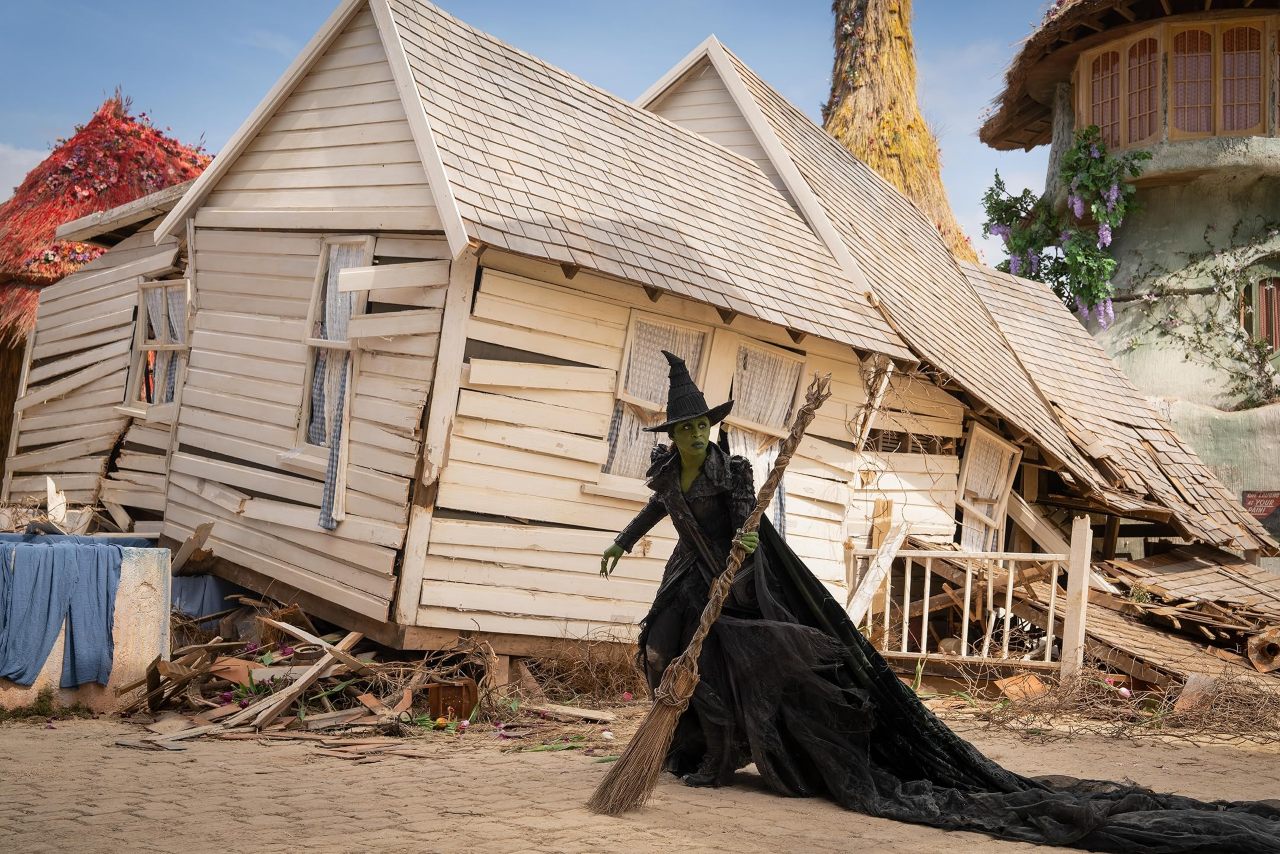
That also brings us to the timeline in Wicked: For Good (which is different to the one in the musical). Are we to seriously believe that Elphaba only makes the decision to be wicked after Dorothy arrives in Oz? Or that Bog was transformed into the Tin Man only about 1-2 days before he met Dorothy? When we first see him as the Tin Man he seems traumatised, while the figure in the public space in the Emerald City has become an angry rabble-rouser – it seems almost impossible to believe that his anger and reaction would have been forgotten and he become the jolly figure who joins Judy Garland in 1939 film, all within the space of a day. Furthermore, this is an origin story that makes nonsense of the lines in the 1939 film where the Tin Man says “About a year ago, I was chopping that tree, when suddenly it began to rain. And right in the middle of the chop, I rusted solid. I’ve been that way ever since,” while his method of creation is contradicted by the line “The tinsmith forgot to give me a heart”. Similarly, The Scarecrow’s origin here is contradicted by the character’s line to Dorothy in the 1939 film: “You weren’t around when I was stuffed and sewn together, were you?”
What we have is not an origin story for the characters of The Wizard of Oz but what is essentially glorified Wizard of Oz fanfiction – one that wrenches the characters out of shape to write them as a best friends forever story, as well as retconning the story to offer pieces of fanservice that connect up. It is bad writing – the sort that might be amusing when you are a teenager obsessed with a show but seems shabby extended to multi-million dollar production that requires you to ignore your memory of the much beloved original. By the time of the ending, which reveals that the bucket of water didn’t kill the Wicked Witch after all and that she had time to duck down into a trapdoor, or the end scene with her setting out across the desert, reunited with her love, The Scarecrow, it felt such a betrayal of the 1939 film that I wanted to throw things at the screen.
Not to mention, all of these rewrites are utterly dismissive of the stories that L. Frank Baum originally wrote, which should be regarded as the canonical texts. In The Wonderful Wizard of Oz (1900) book, The Tin Woodman used to be a flesh-and-blood woodcutter whose axe was enchanted and gradually chopped him to pieces, which were replaced with tin parts, while The Scarecrow was created by a farmer. Not to mention the ending of the film completely contradicts the book sequels that have The Scarecrow takes the place of the departed Wizard as the ruler of the Emerald City as opposed to walking off with Elphaba. Another interesting point is that Baum doesn’t make the two Wicked Witches into sisters – there are four witches for each point of the compass, the two wicked ones occupy east and west, while Glinda is the witch of the north. Also, in Baum, The Wicked Witch of the East is supposed to have kept the Munchkins in thrall for years, not merely issued a decree a couple of days earlier as the film has it.
Director Jon M. Chu had come from a music/dance background with the likes of Step Up 2: The Streets (2008), Step Up 3D (2010) and Justin Bieber: Never Say Never (2011). He has made various non-music/dance works ranging from action films like G.I. Joe: Retaliation (2013), Blumhouse’s disastrous live-action version of the cartoon Jem and the Holograms (2015), Now You See Me 2 (2016) and the big hit of Crazy Rich Asians (2018), as well as the Chinese-language children’s fantasy The Secret of the Magic Gourd (2007).
Trailer here