

Crew
Director – Scott Derrickson, Screenplay – C. Robert Cargill & Scott Derrickson, Producers – Jason Blum, C. Robert Cargill & Scott Derrickson, Photography – Pär M. Ekberg, Music – Atticus Derrickson, Visual Effects Supervisor – Ivan Moran, Visual Effects – Bot VFX (Supervisor – John Britto) & Folks VFX (Supervisor – Phil Prates), Special Effects Supervisor – J.R. Kenny, Production Design – Patti Podesta. Production Company – Crooked Highway.
Cast
Madeleine McGraw (Gwen Blake), Mason Thames (Finn Blake), Demian Bichir (Armando ‘Mando’ Reyes), Miguel Mora (Ernesto Arellano), Jeremy Davies (Terrence Blake), Arianna Rivas (Mustang), Ethan Hawke (Grabber), Maev Beaty (Barbara), Graham Abbey (Kenneth), Anna Lore (Hope), James Ransone (Max)
Plot
It is 1982, Finn Blake is still haunted by his abduction by the serial killer known as The Grabber, which ended with him killing The Grabber. He now has nightmares of The Grabber calling to him. Meanwhile, his sister Gwen is troubled by dreams of young boys that have been murdered. She believes she receives a phone call from her late mother in her dream. This leads her to Camp Alpine Lake, a Christian camp where the boys went missing. She persuades Finn to sign up as a trainee counsellor at Camp Alpine. Finn, Gwen and Gwen’s would-be boyfriend Ernesto travel up to the camp, arriving in the midst of a snowstorm. There Gwen believes that the murdered boys are calling to her to find their bodies.
The Black Phone (2021) was a modest hit for director Scott Derrickson. Derrickson had ridden a wave of popular genre hits with the likes of The Exorcism of Emily Rose (2005), the remake of The Day the Earth Stood Still (2008), Sinister (2012), Deliver Us From Evil (2014), The MCU’s Doctor Strange (2016) and The Gorge (2025). The Black Phone was adapted from a story by Joe Hill.
The Black Phone earned some $161 million worldwide. For Blumhouse, such a success always mandates a follow-up if not a whole series and Black Phone 2 is a sequel. Apparently, Joe Hill suggested the idea when he called Scott Derrickson up with the pitch “The Grabber calls from Hell.” This does lead to many of the problems with most sequels in that the original was a self-contained work. However, Derrickson and his regular co-writer C. Robert Cargill solve this in some interesting ways.
The nature of the story being told has changed between the films. The Black Phone was a creepy film about a kid imprisoned by a serial killer while receiving messages from the beyond on a dead telephone. Here that has changed – the serial killer is dead and joins the others in delivering messages from beyond the grave, while the focus has changed from an abduction story to merely a work about finding the dead bodies of The Grabber’s previous victims. Indeed, Black Phone 2 doesn’t even feature Finn as the main character but puts him in second place and promotes his sister Gwen to the main character.
In effect, what we now have feels like a variant on the Clairvoyant or Medium film where someone speaks with the dead or follows a series of premonitions to solve a mystery. This is combined with what is in effect a Haunted House story, albeit set outdoors, where someone experiences a series of malevolent and scary hauntings and realises that they are being called to aid the ghosts of the dead who are calling out for expiation.
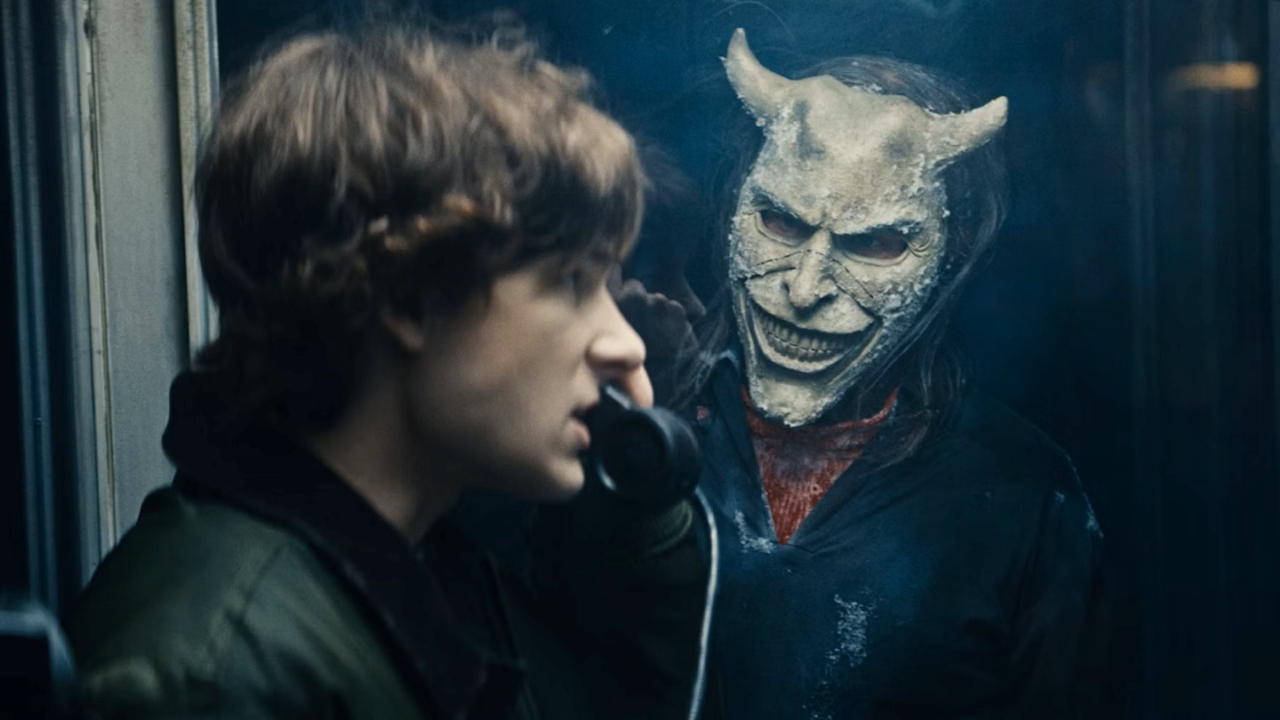
Black Phone 2 is slow to start. Nothing much seems to be happening for the first thirty minutes through the initial scenes with Madeleine McGraw and Mason Thames having dreams and seeing figures. It is not until we reach the camp that the film starts to have some effect. There is quite a terrifying scene where Madeleine McGraw has a dream and sees burned figures, bloodied hands on the windowpane and one boy who gets head sliced in two by the falling window and keeps talking. There is another terrifying scene a little later on where the ghostly Grabber attacks Madeleine in the kitchen and tries to throw her into the flaming oven. It all works out into what, by the end, becomes quite a strong story.
I can remember a few years ago when Scott Derrickson would turn up on various Worst Directors lists that regularly appeared on the IMDB. Nowadays there is no such doubt about things and Derrickson is a director with a confident mastery of the art. By the point of Black Phone 2 and particularly with The Gorge earlier in the year, you can say Derrickson has finally started to emerge as a filmmaker who can do impressive things. (His son Atticus also composes the film’s score and does not a bad job either – I really want a copy of the track that plays over the opening credits).
Derrickson chooses the setting of a Christian summer camp. While watching, I kept wondering how much of this was Derrickson drawing on his own background – he is a professing Christian and such themes weave in and out of a number of his films, most notedly Emily Rose and Deliver Us from Evil. Certainly, if that is the case then Black Phone 2 also shows Derrickson more than happy to be critical of such, in particularly the judgemental and controlling behaviours of the Barbara woman who readily condemns Madeine McGraw as possessed or being a witch.
Scott Derrickson first appeared with Hellraiser: Inferno (2000) and then had a worldwide hit with The Exorcism of Emily Rose (2005), a based-on-a-true-story film about an exorcism. Derrickson subsequently went onto the not uninteresting remake of The Day the Earth Stood Still (2008), the horror film Sinister (2012), Deliver Us From Evil (2014) based on the supposedly true-life account of a New York detective encountering demonic forces, the adaptation of Marvel Comics’ Doctor Strange (2016), the Dreamkill episode of V/H/S/85 (2023) and the monster movie The Gorge (2025). Derrickson has also written Urban Legends: Final Cut (2000), provided the story for Wim Wenders’ Land of Plenty (2004) and produced the Christian horror film The Visitation (2006), the horror film Kirsty (2014), Sinister 2 (2015) and Doctor Strange in the Multiverse of Madness (2022), as well as wrote/produced Devil’s Knot (2013) based on the true story of three teenagers in West Memphis Three who were convicted of Satanic ritual murders on next-to-no-evidence.
Trailer here