


Crew
Director/Screenplay – Sophie Barthes, Producers – Nadia Kamlich, Genevieve Lemal, Martin Metz & Yann Zenou, Photography – Andrij Parekh, Music – Evgueni Galperine & Sacha Galperine, Visual Effects – Benuts (Supervisor – Ronald Grauer), Special Effects – Level 9 Effects (Supervisor – Sefian Benssalem), Production Design – Clement Price-Thomas. Production Company – Quad/Scope Pictures/Align/MK2 Films/Multiversx/Magical Thinking Pictures/Canal +/OCS/Wallimage/The Belgian Federal Government Tax Shelter Via Scope Invest/BeTV/Proximus/RTBF/Echo Studio/Benuts/Aden Film.
Cast
Emilia Clarke (Rachel Novy), Chiwetel Ejiofor (Alvy Novy), Rosalie Craig (Linda Woyzchek), Vinette Robinson (Alice), Jean-Marc Barr (Pegazus Founder), Alix Dunmore (Voice of Eliza)
Plot
New York City in the future. Wife Rachel Novy works as a corporate executive, while husband Alvy is a botanist who tries to impart the beauty of nature to his students. Rachel now takes over an account for Pegazus who run The Womb Center. They have created a process whereby a foetus is allowed to externally gestate inside an egg-shaped shell. Rachel has signed up for the Pegazus program without telling Alvy and they are now accepted. Alvy gradually comes around to the idea of having a child by this artificial process and their egg is born.
The Pod Generation was the third film from French-American director/writer Sophie Barthes. Barthes first appeared with the SF film Cold Souls (2009) where people can remove their souls and went on to an adaptation of Madame Bovary (2014).
I liked Sophie Barthes’ previous venture into SF with Cold Souls, which played its ideas with an appealing quirkiness. When it came to The Pod Generation, the premise of a world where people have babies in external wombs is one that did nothing for me as the central idea for a film. On the other hand, soon into the film I was being taken by the interesting touches that Barthes places into the background of her future – where Chiwetel Ejiofor’s breakfast is being 3D printed, while he and Emilia Clarke chat away with a sometimes annoyingly helpful house A.I.; where Chiwetel has a specialty in holographic plant design and Emilia Clarke works at a stand-up desk that also comes with a built-in walking machine for a company that manages social media profiles, and goes to attend sessions with an A.I. therapist.
I am not completely sure if Emilia Clarke and Chiwetel Ejiofor connect as a couple on screen. Chiwetel is great in everything he does as always. Emilia Clarke came to fame as Daenaerys in tv’s Game of Thrones (2011-9) and seemed assured of a career after that – she was even cast as Sarah Conner in Terminator: Genisys (2015). However, outside of that, she has done nothing that has stood out. Game of Thrones gave her a great autocratic role served by some fantastic writing. On the other hand, most filmmakers have taken Clarke out of that role and simply given her banal romantic leads or girlfriend roles where, not able to exude the same kind of regal authority, she just seems a 5’2” waif that disappears inside the scenery as is the case here. Here even her makeup gives her an unnatural pallor.
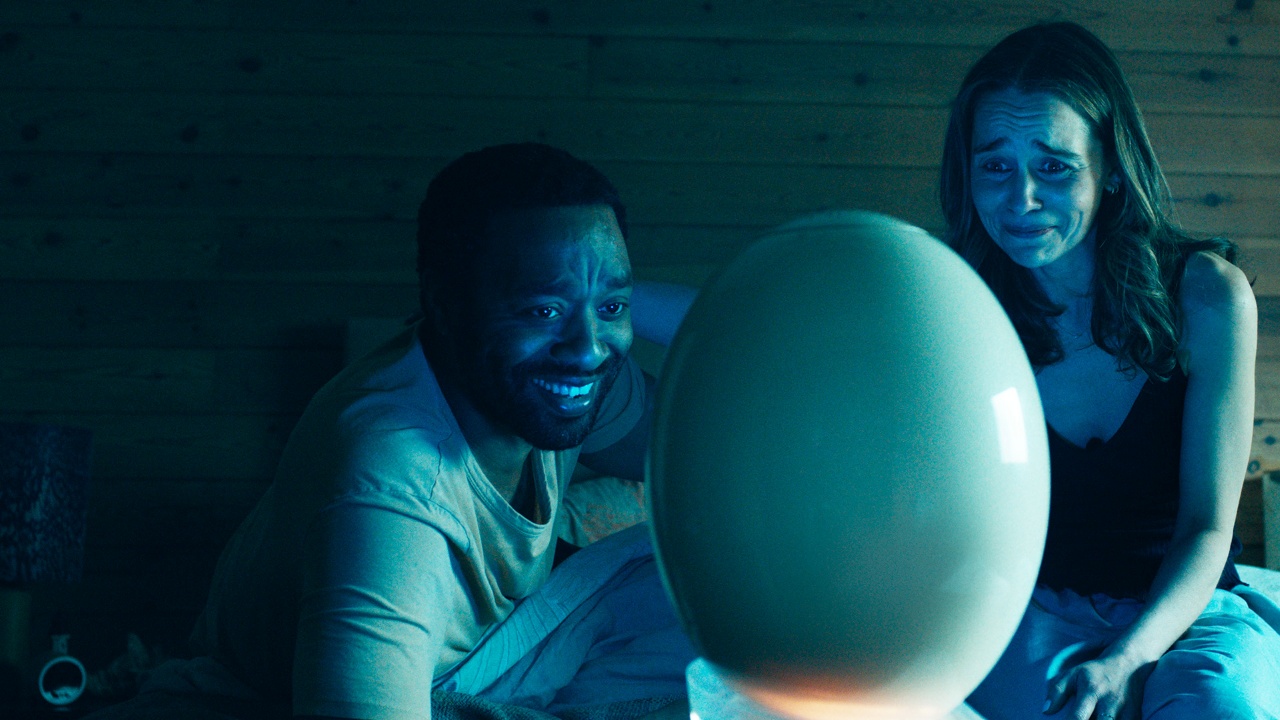
The problem with The Pod Generation is that Sophie Barthes has an idea – I don’t think it is a great idea, but I can see ways it could be developed. The film bubbles with satiric potential, especially when it comes to the scenes at the corporate headquarters and the parroting of corporate niceties about baby-rearing and especially at the end when Emilia and Chiwetel announce their intentions to have the baby naturally and corporate CEO Rosalie Craig tries to remind them the baby is being hatched in corporate property. What it feels like is an episode of Black Mirror (2011- ) that just needed a nudge further along to find its true blackly satiric potential.
But the failing of The Pod Generation is that none of it goes anywhere. Emilia Clarke and Chiwetel Ejiofor decide to have a baby in an egg-shaped pod, he takes a while to come around to the idea but is soon a devoted expectant father. That is about the whole film. The satire bubbles but never develops any bite. There is some dramatic complication towards the end where they decide to defy the corporation’s methods and have a home birth. In another film like say The Last Child (1971) or Z.P.G (Zero Population Growth) (1972), they would become fugitives from the evil corporation, fighting to have their baby naturally. However, the film here ends with them cracking the egg open and then cuddling up with the baby. I half expected this would be the point the corporation would crack down on them for destruction of proprietary equipment, but the film just trails off with a warm fuzzy end with no real dramatic tension ever engendered.
Trailer here