

Crew
Director – Lee Sholem, Screenplay – Philip MacDonald, Story – Carl Dudley, Producer – Richard Goldstone, Photography (b&w) – John L. Russell, Jr., Music – Howard Jackson, Optical Effects – Consolidated Film Industries, Special Effects – Howard Lydecker & Theodore Lydecker, Art Direction – Gabriel Scognamillo. Production Company – Dudley Pictures Corporation.
Cast
Charles Drake (Dr Philip Harrison), Taylor Holmes (Professor Arnold Nordstrom), Billy Chapin (Brian ‘Gadge’ Roberts), Karin Booth (Janice Roberts), Steven Geray (Head Spy), Franz Roehn (Karl), [uncredited] Alan Reynolds (Gilligan)
Plot
The US Government has formed the Civil Interplanetary Flight Commission to manage the job of launching mankind into space. After seeing men subjected to high g forces in a centrifuge, Dr Philip Harrison quits the program in disgust, not wanting to see men tortured for the purpose of spaceflight. He is approached by Professor Arnold Nordstrom who asks him to come to his home laboratory in California. There Nordstrom unveils Tobor, robot spelt backwards, a machine designed to take over the job of a man on a space mission. Nordstrom needs Harrison’s job in perfecting a system that allows Tobor to be controlled by thought. Nordstrom’s grandson Brian or ‘Gadge’ is bright and figures out how to control Tobor. However, foreign spies are making plans to steals the secrets of Tobor.
Depiction of Robots in the 1950s tended to be of the sinister amok variety as in films such as Robot Monster (1953), Gog (1954), Target Earth (1954) and The Colossus of New York (1958). There was Gort in The Day the Earth Stood Still (1951) whose purpose was neutral. The sole machine that was unquestionably on our side is one of the most loved robots in science-fiction – Robbie the Robot in Forbidden Planet (1956), although by the time of the sequel The Invisible Boy (1957), Robbie had gone over to the dark side as he came under the influence of an evil super-computer.
One film that predates Forbidden Planet but has almost completely been ignored is Tobor the Great – it did the whole idea of the robot that could be programmed according to Asimov’s Three Laws of Robotics first and yet is a work that is almost completely overlooked in most genre histories and guides. I am not quite sure the reason for that – perhaps that it is an atypical 1950s SF film, featuring neither atomic monsters or alien invaders thus fits into no easy niche for the era. The plot is light and knockabout and yet the film is a solid entry in the 1950s SF film and nothing to be ashamed about.
Despite not falling into any 1950s genre niches, Tobor the Great still offers a unique snapshot of both the Space Age and the Atomic Age. Both come up during the opening montage, although atomic fears are dropped after that point. However, the film proves a fascinating depiction of spaceflight just before the whole Space Age kicked off – the Mercury Program would be four years away and Sputnik, Laika and Yuri Gagarin a few years beyond that. It is rather amusing where we go from astronaut candidates in a centrifuge to Charles Drake adamant that spaceflight is too dangerous for humans therefore we are better off making unmanned launches, where the obvious solution (as we see in the final scenes) is sending a robot up into space. A number of other films of this era like Conquest of Space (1955), The Quatermass Xperiment (1955), War of the Satellites (1958) and First Man Into Space (1959) were filled with similar fears that venturing out into space would be too much for humanity to handle.
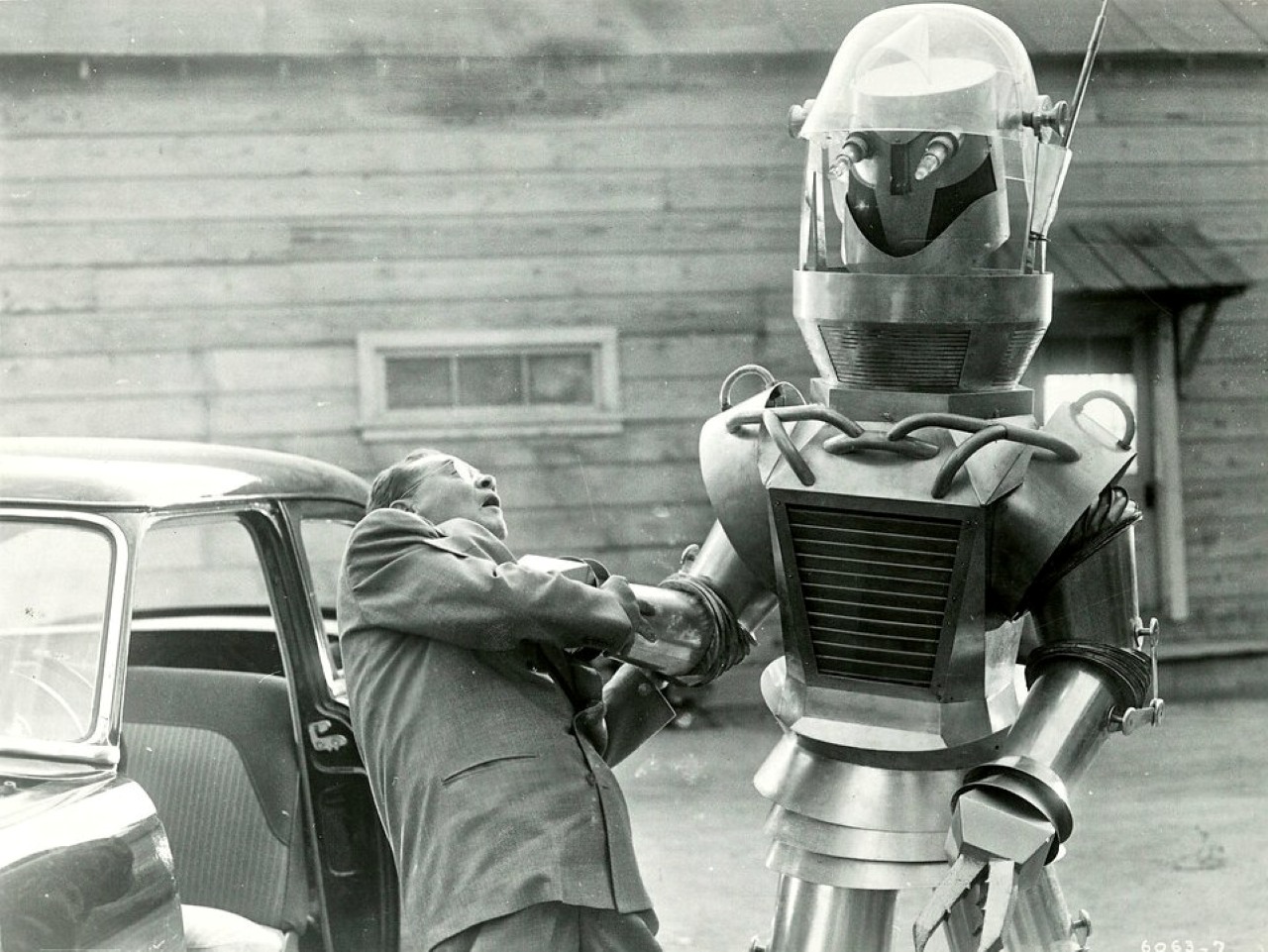
Tobor the Great also features two of the few benevolent scientists of the era at complete contrast to the Mad Scientists who dominated 1930s and 40s genre cinema. In fact, we get two-and-a-half scientists for the price of one – Taylor Holmes as the eccentric grandfatherly professor and nominal hero Charles Drake who immediately snaps into position to scoop up the professor’s daughter and act as father figure to young Gadge (Billy Chapin), bringing everything into place as a happy substitute nuclear family ideal of the day. Gadge is one of the first precocious teen geniuses whose curiosity always gets the better of him with comic results – the professor ends up being incredibly forgiving when Gadge gets Tobor working and nearly demolishes the living room. The precocious boy with the robot companion became a regular genre trope subsequently as in The Invisible Boy, tv’s Lost in Space (1965-8) and The Iron Giant (1999).
Tobor itself is an impressive creation when unveiled (although there is no truth at all to the claim made that it was designed by Forbidden Planet’s Robert Kinoshita). Although, just like the A.I.’s in Star Trek (1966-9), it can be made to have an information overload and short circuit when faced with too many variables or imponderables.
There is also a series of what today seem hilariously dated gadgets, including an automatic front gate opener that operates on radio frequencies – today we call it the garage door opener. There is a bizarrely elaborate sequence of books on a shelf that have to be rearranged and photoelectric alarms triggered to get access to the laboratory (which is left open quite a bit of the time anyway). The funniest of these is when the spies invade the property and are driven away by the audio recordings of warfare – recorded from Iwo Jima, the professor tells us – and flashing lights to make them think they are being attacked.
Lee Sholem (1913-2000) was a director of B-budget Westerns and adventure films during the 1940s and 50s. He directed the first two Lex Barker Tarzan films Tarzan’s Magic Fountain (1949) and Tarzan and the Slave Girl (1950) and Johnny Weissmuller in two of his non-Tarzan jungle adventure films Jungle Man-Eaters (1954) and Cannibal Attack (1954). Sholem also made several other B genre films with Superman and the Mole Men (1951); the mummy film The Pharaoh’s Curse (1957); and the sf film Doomsday Machine (1972).
Trailer here
Full film available here