
Crew
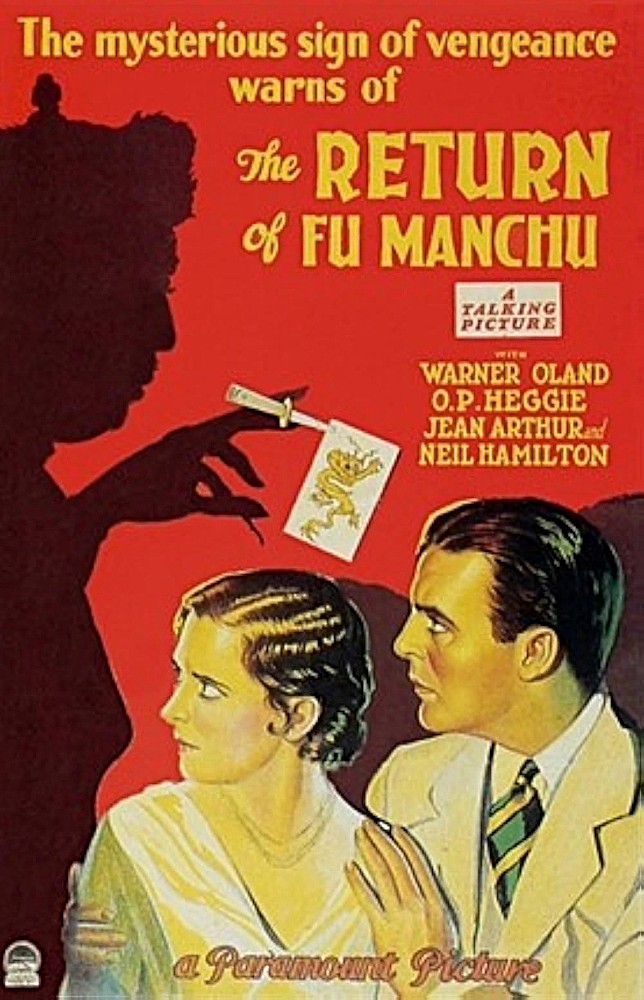
Director – [Uncredited] Rowland V. Lee, Screenplay – Lloyd Corrigan & Florence Ryerson, Based on the Novel The Devil Doctor/The Return of Dr Fu Manchu (1916) by Sax Rohmer, Producer – Rowland V. Lee, Photography (b&w) – Archie J. Stout. Production Company – Paramount.
Cast
Warner Oland (Dr Fu Manchu), O.P. Heggie (Nayland Smith), Jean Arthur (Lia Eltham), Neil Hamilton (Jack Petrie), Evelyn Hall (Lady Agatha Bartley), William Austin (Sylvester Wadsworth), Margaret Fealy (Lady Helen Bartley), Shayne Gardner (Inspector Harding), Evelyn Selbie (Fai Lu)
Plot
A funeral is held for the late Fu Manchu. However, Fu Manchu has merely taken a drug that has affected death-like paralysis and comes around after the funeral is over. Meanwhile, Jack Petrie and Lia Eltham are preparing to get married. Fu Manchu’s Dacoits invade the house before the ceremony and snatch Lia. Fu Manchu demands that Petrie, the one last victim he has sworn to kill, comes to meet him alone. Nayland Smith has police waiting but Fu Manchu outwits them by snatching Petrie and getting away in a biplane. Only when they arrive back at Fu Manchu’s base, it is discovered that Nayland Smith has substituted himself for Petrie. A battle of wits ensues between the two as Fu Manchu insists that Nayland Smith drink a poison that will destroy his mind.
Fu Manchu is one of the great cinematic Super-Villains. Fu Manchu first appeared in a series of novels by Sax Rohmer, the pseudonym of British journalist Arthur Henry ‘Sarsfield’ Ward (1883-1959), beginning with The Mysterious Dr. Fu Manchu/The Insidious Dr Fu Manchu (1913). Rohmer went on to write thirteen Fu Manchu novels, four short stories and a play. These enjoyed great success and were adapted to film and radio and even saw entire magazines featuring copycat Chinese villains with the likes of Dr Yen Sin and The Mysterious Wu Fang. (See bottom of the page for the other Fu Manchu films). The film here is very loosely adapted from the second of Rohmer’s Fu Manchu’s novels The Devil Doctor, which was later retitled The Return of Dr. Fu Manchu.
The first Fu Manchu film was The Mysterious Dr. Fu Manchu (1929) from Paramount starring Warner Oland. It was followed by The Return of Dr. Fu Manchu here and the subsequent Daughter of the Dragon (1931). The Return of Dr. Fu Manchu is a considerable improvement over the first film. It makes the move over to sound for one. It is an impressively made production in many respects. The sets for the Petrie mansion come with cavernous size and are decorated with an eye to impress.
The first film was mostly set around a mansion, whereas this expands the dramatic scope of the story considerably. There is a fabulous scene where Fu Manchu’s Dacoits slip unnoticed into the Petrie estate. The first they are detected is when one man pokes his head out the window and is abruptly snatched upwards by a noose around his neck. Meanwhile, as Lia (Jean Arthur) and Evelyn Hall stand in shock, a cupboard door opens behind them and the lights go out. By the time, Neil Hamilton’s Petrie rushes in the women are gone. He is nearly shot by blow dart from a waiting Dacoit on the roof. This contains a taunting note from Fu Manchi, telling how he intends to torture Lia. Petrie goes off to Fu Manchu’s rendezvous while Nayland Smith is waiting with forty police cars, only for Fu Manchu to outwit them all by taking off in a biplane that has been hidden behind a fake hedge with an abducted Petrie aboard.
The scenes at Fu Manchu’s lair become a superlative battle of wits between Fu Manchu and Nayland Smith, with the latter having substituted himself for the abducted Petrie and trying to outwit Fu Manchu’s plan to give him a poison that will destroy his mind. Nayland Smith even comes with nifty gadgets such as a cigar case that handily rearranges as a flare gun to fire up the chimney in order to alert their position. Fu Manchu also has a drug that can make people do anything he tells them to – it is not clear if this is the same drug he is trying to give Nayland Smith – and he demonstrates it on one of Nayland Smith’s subordinates later in the film. The film arrives a great climax with Petrie blackmailed into operating on a wounded Fu Manchu with threat of a Fu Manchu giving Lia the zombie drug. When cornered, Fu Manchu threatens to blow them all up with a grenade he is holding, before Nayland Smith simply opens the door and kicks Fu Manchu out into the river.
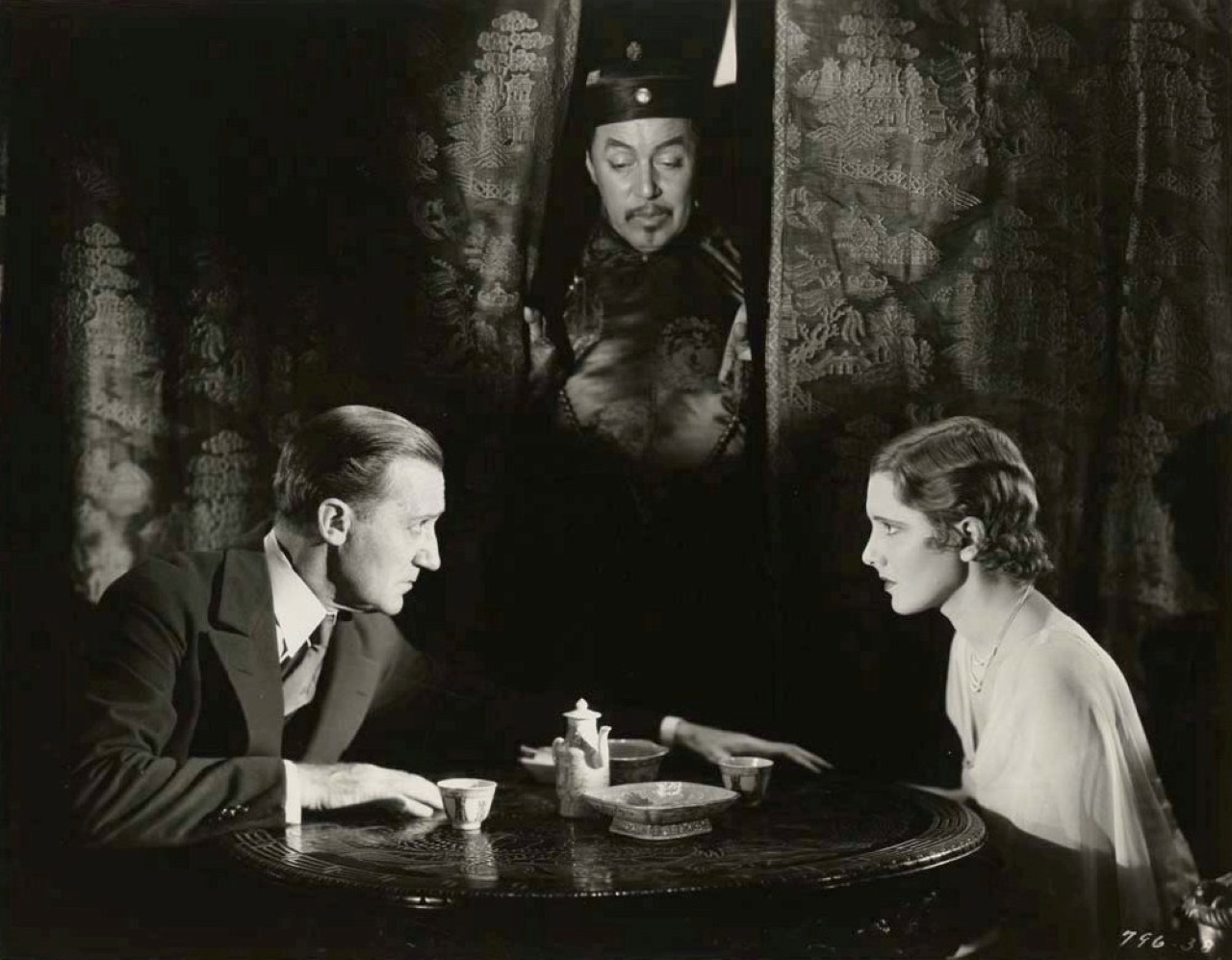
One of the minus points of these Paramount Fu Manchu films is the casting in the title role of Warner Oland, a Swedish and very non-Asian actor, later most famous for playing Charlie Chan. These Fu Manchu films do require that you have a very tolerant or forgiving attitude towards 1930s era racial stereotypes – they are not films recommended for those likely to be offended. I will defend them because I am not a fan of judging older works by contemporary standards and they have many laudable aspects outside of that. One of the things that does play out in The Return of Dr. Fu Manchu is the undercurrent of the horror of a white woman in the hands of an evil Asian villain – Jean Arthur is abducted in her wedding dress and lies helpless in her cell as Warner Oland leers at her from the grate overhead, while promising tortures.
Oland makes a rolypoly Fu Manchu. His hunched over, dramatic over-exaggeration is something that is almost a comical caricature today. Not the mention the cackling, pudgy Oland is almost the complete antithesis of the definitive Fu Manchu later essayed by an autocratic and icy cold Christopher Lee. Another minus aspect is Petrie’s best friend/best man William Austin who is played with a fey craven manner – he is prone to hysterics and needs to go and have a good cry to sort himself out at one point – which is something that would almost be mandatorily played as a flamboyant gay caricature in a modern film.
The other Fu Manchu films include:– a series of 23 short silent British films made between 1923 and 1924 starring H. Agar Lyons as Fu Manchu, all of which appear to be lost today; the excellent The Mask of Fu Manchu (1932) with Boris Karloff; a fifteen chapter serial The Drums of Fu Manchu (1940) from Republic starring Henry Brandon; the tv series The Adventures of Fu Manchu (1956), which only lasted for eleven episodes, starring Glen Gordon; the film series starring Christopher Lee produced by Harry Alan Towers, which consisted of The Face of Fu Manchu (1965), The Brides of Fu Manchu (1966), The Vengeance of Fu Manchu (1967), The Blood of Fu Manchu/Kiss and Kill (1968) and The Castle of Fu Manchu (1969); and The Fiendish Plot of Dr Fu Manchu (1980), a parody that featured Peter Sellers in his last performance playing both Fu Manchu and Nayland Smith.
The film was directed by Rowland V. Lee (1891-1975), who also made the previous film – in both, he is oddly is credited as the producer but not as the director. Lee made a number of films throughout his career, including versions of The Count of Monte Cristo (1934) and The Three Musketeers (1935). He made a bare handful of other forays into genre territory with the psycho-thriller Love from a Stranger (1937); the third of Universal’s Frankenstein films Son of Frankenstein (1939); and the Boris Karloff-Basil Rathbone historical starring film Tower of London (1939), which has horror overtones.
Full film available here