
New Zealand. 1985.
Crew
Director – Geoffrey Murphy, Screenplay – Bill Baer, Bruno Lawrence & Sam Pillsbury, Based on the Novel The Quiet Earth (1981) by Craig Harrison, Producers – Don Reynolds & Sam Pillsbury, Photography – James Bartle, Music – John Charles, Special Effects – Ken Durley, Production Design – Josephine Ford. Production Company – Mr Yellowbeard Productions.
Cast
Bruno Lawrence (Zac Hobson), Alison Routledge (Joanne), Peter Smith (Api)
Plot
Scientist Zac Hobson wakes up one morning to find himself completely alone. As he searches the area, it becomes increasingly apparent that he is the only man left alive. Everybody else has just vanished, even in the midst of activity – kettles left boiling, vehicles still running, a plane crashed with all the seatbelts still fastened in place. Investigating, Zac finds that Operation Flashlight, a project he was working on to set up a worldwide energy grid, has been activated, causing a fundamental change in the structure of matter. Wandering alone, Zac’s sanity swings between euphoria and despair at his isolation. He then meets another survivor Joanne and they become lovers. That is until the appearance of a third survivor Api, which serves to create a triangle of tensions as Joanne becomes involved with him. At the same time, Zac becomes aware that the energy grid is causing the universe to become increasingly more unstable.
Geoff Murphy (1938-2018) is one of the most celebrated New Zealand film directors. Murphy emerged out of a unique travelling musical cooperative/hippie commune created by he, Bruno Lawrence and called Blerta that travelled the country in a bus performing. Murphy made several short films and then the full-length Gold Rush comedy Wild Man (1977) also starring Bruno Lawrence. From there, Murphy went on to the hit of Goodbye Pork Pie (1980), a loose and freewheeling chase movie, which had an anarchic, anti-authoritarian tone that gained it a cult and made it for many years the most successful film ever made in New Zealand. Murphy went onto further success with Utu (1983), an historical drama that mounted the 1840s Maori Wars as an epic Western of sorts. Then Murphy made The Quiet Earth, which gained him an international reputation and subsequently found him in employ in the American mainstream. (See below for Geoff Murphy’s other genre films).
The Quiet Earth is an end of the world film. But it is one where Murphy veers away from any association with other contemporary voices on the subject such as the post-apocalyptic action movie of Mad Max 2 (1981) and its numerous clones. Instead, he returns to the 1950s mini-genre of Last People on Earth dramas such as Five (1951), Day the World Ended (1955), The Last Woman on Earth (1960) and The Last Man on Earth (1964). In particular The Quiet Earth reminds of The World, the Flesh and the Devil (1958), which featured an interracial triptych of survivors – a white man and a black man fighting over a white woman – something that caused somewhat of a sensation at the time with its inter-racial affair. There was also the tv movie Where Have All the People Gone (1974) in which a mysterious catastrophe causes all but a handful of survivors to vanish, leaving only empty clothes behind
The Quiet Earth is at its most effective in conveying the barrenness of humanity’s absence. It all starts with a mildly puzzling mystery as Bruno Lawrence wakes up and the ordinary starts to become increasingly more strange with nobody at the petrol station, the toilet locked and occupied but nobody inside, kettles left boiling, a furrow left where somebody has been sleeping in a bed, vehicles run off the side of the road. The whole soundtrack was re-dubbed in the studio to remove all trace of everyday sounds. If possible, see the film in a theatre with a stereo system – the sudden ringing of a telephone or the rolling of an unseen can from one side of the speakers to the other makes the desolation seem even more absolute by its interruption.

During these scenes, Geoff Murphy gets inside Bruno Lawrence’s emotional rollercoaster of being the only man left in the world. The scenes with Bruno Lawrence cracking up are conveyed in a striking, often playful, collages of images – he drinking champagne, taking whatever material possessions he wants including filling his hotel room with works of art. wandering about in a ladies’ slip, driving full-size trains as though it were a toy train set, and one beautiful image of him wandering in the rain playing the sax.
In seemingly keeping with the spirit of Goodbye Pork Pie, which was one giant car chase about thumbing its nose at authority, Murphy conceives the aftermath of the apocalypse as a giant boy’s toys fantasy – the tongue-in-cheek image of Bruno Lawrence dressed in a cop’s uniforms cruising the streets in a patrol car, demolishing buildings in a bulldozer, and an especially amusing scene that cuts between Lawrence playing with a train set to driving full-size trains. Murphy also allows his typically idiosyncratic sense of humour to intrude, with scenes of Bruno Lawrence ranting at cardboard cutouts of world leaders and charging through a church yelling “Where are you? [to The Almighty]” and challenging a statue of Christ with a shotgun “Come out or the kid gets it.”
For a time during the 1980s, up until his death in 1995, with his mixture of roughhewn charm that could easily explode into violence, Bruno Lawrence crafted a presence as the quintessential New Zealand man – a character who is awkward when it comes to emotions and easily prefers his own company than the rest of society. [In an interesting trivia note, Murphy and co tried to get Jack Nicholson for the Bruno Lawrence role but turned him down when he demanded $4 million and 25% of the film’s profits].
Far less effective is when the film abandons the lyrical, visual poetry of isolation and introduces two other characters in the second half. Here The Quiet Earth merely becomes a trite love triangle – and one that is not entirely satisfactorily dealt with. Certainly, Alison Routledge’s sparkly fairydown performance and Peter Smith as the aggressive Api give decent performances. However, rather than offer any satisfactory or dramatic closure to the triangle, the film jams its brakes on full stop, leaving everything unfinished. We never understand anything of the games that Alison Routledge appears to be playing, variously leading either man on. Much of problem is that the script was still being written during the shooting. Moreover, the film has largely abandoned much of Craig Harrison’s 1981 novel, which was modelled as a J.G. Ballard-esque journey through inner terrain.

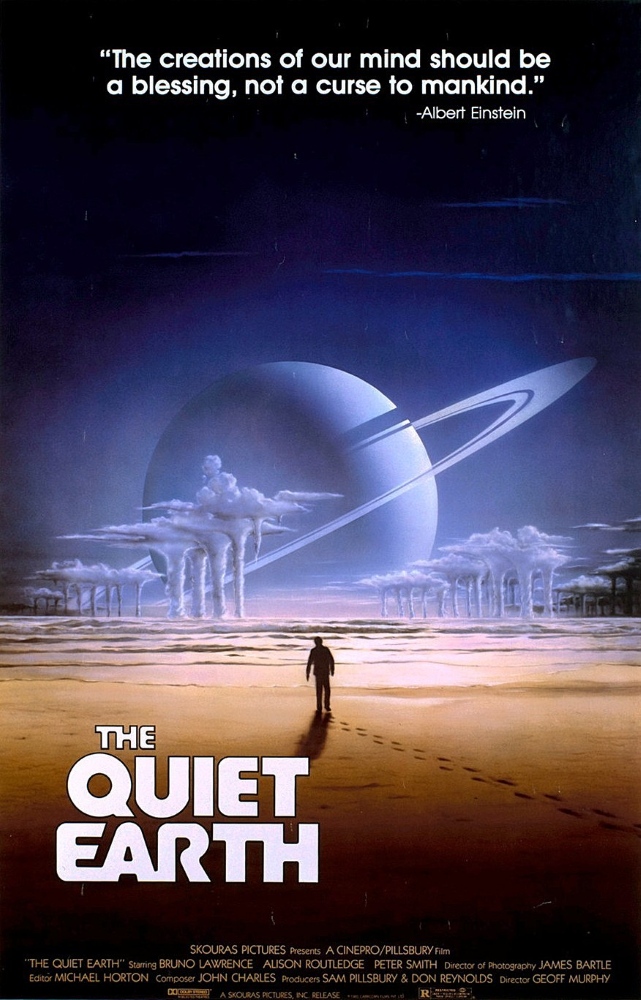
And then of course that brings one to the ending. What exactly happens or what it all means is entirely baffling. [SPOILER ALERT]. Here the world undergoes another of the reality shifts that have been occurring throughout. This time though after it happens Bruno Lawrence inexplicably finds himself on a beach as a ringed planet rises up in the sky above him. (Well, it’s not too much of a surprise as the film’s poster used this very image to promote the film). But it is baffling in that there is no answer offered to what this place is or exactly what has happened. Nor are we offered any answer to any of the questions raised in the film – like where everybody else went to.
Here Murphy and co seem to be wanting to aim for something like 2001: A Space Odyssey (1968) with its enigmatic journey into psychedelic space or The Picnic at Hanging Rock (1975), a seemingly paranormal mystery that deliberately withheld any answer as to what happened, and particularly Solaris (1972), which reached the same kind of puzzlingly transcendental resolution. These aforementioned films worked beautifully due to painstaking elaboration of their enigmas, with meanings and explanations carefully left just beyond the grasp of an audience. But The Quiet Earth smacks of an ending that leaves a mystifyingly blank titillation, something that has been randomly dreamed up, borne out of a not knowing how finish the film than anything else. It is something that leaves all audiences confused.
The years since have seen a surprising number of other films take up The Quiet Earth‘s premise of a small handful of people waking up to find themselves in a mysteriously deserted world where the explanations for such are frequently left enigmatic and unexplained. See also the likes of The End of the Animal (2010), The Last Seven (2010), Vanishing on 7th Street (2010), The Midnight After (2014) and Alone (2017) and Bokeh (2017). The Australian-made A Guide to Dating at the End of the World (2022) was a romantic comedy take on The Quiet Earth.
Geoff Murphy’s subsequent career in the American mainstream was entirely one of mediocrity, including the likes of the action film the Western Young Guns II (1990), the sf film Freejack (1992), the Steven Seagal vehicle Under Siege 2: Dark Territory (1995) and Fortress 2: Re-Entry (2000). Nowhere in any of these is to be found any of the energy and anarchic humour that fuelled Murphy’s three best New Zealand productions, Goodbye Pork Pie, Utu and The Quiet Earth. Murphy also co-wrote the haunted car/stalker film Mr Wrong/Dark of the Night (1985) for director Gaylene Preston. In later years, Murphy returned to New Zealand to direct second unit on Peter Jackson’s The Lord of the Rings: The Fellowship of the Ring (2001) and sequels and then went on to make the rather silly true life conspiracy film Spooked (2004).
Trailer here