

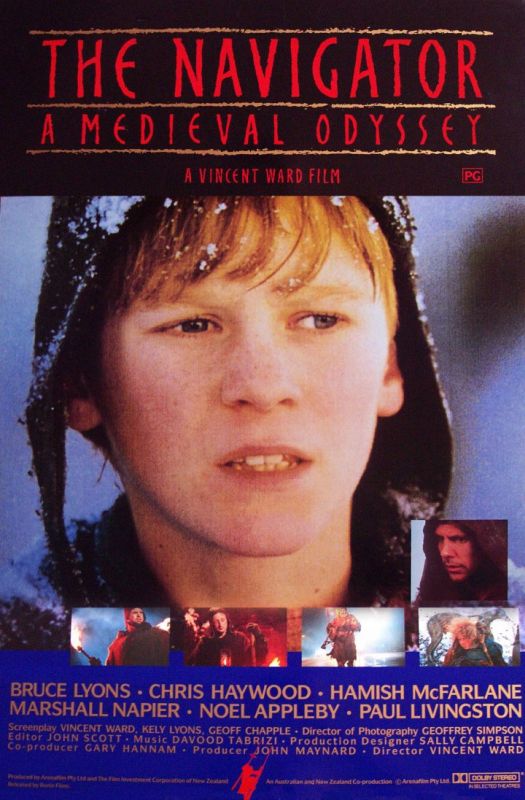
New Zealand/Australia. 1988.
Crew
Director/Story – Vincent Ward, Screenplay – Vincent Ward, Geoff Chapple & Kely Lyons, Producer – John Maynard, Photography (b&w + colour) – Geoffrey Simpson, Music – Davood A. Tabrizi, Photographic Effects – Mirage Effects Pty Ltd, Special Effects Supervisor – Paul Nichola, Production Design – Sally Campbell. Production Company – Arena Films/The Film Investment Corporation of New Zealand/The Australian Film Commission/The New Zealand Film Commission.
Cast
Hamish McFarlane (Griffin), Bruce Lyons (Connor), Marshall Napier (Searle), Noel Appleby (Ulf), Chris Haywood (Arno), Paul Livingston (Martin), Sarah Pierse (Linnet), Desmond Kelly (Smithy), Jay Lavea Laga’aia (Jay), Bill Le Marquand (Tom)
Plot
The year 1348 in a small village in Cumbria. The villagers are besieged from the outside world by carriers of the Black Death. Young Griffin has a vision that the plague will pass the village over if the villagers make a pilgrimage to carry a cross to a city of lights and mount it on a cathedral before dawn rises. Led by Griffin’s vision, a group of miners tunnel down to the centre of the earth and emerge out into modern day Auckland. They find this new world frightening and bewildering. As they search for the cathedral, Griffin has a vision that one of them will die before dawn.
If there is ever a list of directors who make far too few films, then the name of Vincent Ward must surely sit at the very top of that list. Vincent Ward is one of the most exquisitely painterly of all directors. He crafts entire films with painstaking minutiae to detail and the play of light. Ward was born in New Zealand and first impressed with two celebrated but nowadays impossible to find shorts, A State of Siege (1978) and the documentary In Spring One Plants Alone (1981), before emerging onto cinema screens with the feature-length Vigil (1985), a complex, beautiful film that almost entirely sidesteps narrative for a striking series of primal moods and images, all entirely about the play of light, mud and the Earth.
The Navigator: A Medieval Odyssey was Vincent Ward’s second film and is a concession to a much more commercial form of filmmaking, particularly in areas like plot, although is no less beautiful a film than Vigil. The Navigator received a rapturous response at various international film festival screening – indeed won the Palme d’Or at Cannes that year – and had Vincent Ward’s star touted in Hollywood. Ward turned down the opportunity to helm several mainstream productions, including The Neverending Story II: The Next Chapter (1990) and Robocop 2 (1990). He subsequently became one of the numerous directors attached to the development revolving door that was Alien3 (1992), where he came up with a mind-boggling scenario that wound in monks, a wooden planet and saw the alien as fulfilment of various religious prophecies – although eventually only ended up with story credit on a muchly watered down version of his vision.
After that, Ward subsequently bummed around Hollywood directing commercials to make ends meet. He was attached to a fascinating sounding version of the epic legend Beowulf at one point but failed to find the financing and later developed The Last Samurai (2003) but saw it taken over by another director. He did manage to get the Inuit romance Map of the Human Heart (1992) off the ground, which proved a rather glacial and distant film that left audiences disappointed on the promise that Ward was seen as holding as a result of The Navigator, although the film does have a stunning vision of the Wartime Blitz of London that is pure Ward. Ward however recovered with the quite amazing afterlife fantasy What Dreams May Come (1998), wherein the employment of modern CGI effects allowed him to craft three-dimensional realisations of classical works of art. Subsequently, Ward returned to New Zealand to make the troubled River Queen (2005), a drama set during the Maori Wars, and the quasi-documentary Rain of the Children (2008) about a Maori curse.
The Navigator: A Medieval Odyssey was released amidst the maturation of Time Travel films that came about as a result of the successes of The Terminator (1984) and Back to the Future (1985). Although what is noticeable about comparison between The Navigator and these other films is the backgrounds that their various directors draw upon. With The Terminator, James Cameron draws upon a reading of SF literature, while in Back to the Future Robert Zemeckis draws upon a childhood love of screen SF. Vincent Ward by contrast comes from a formal arts background and draws upon a love of classical art. The focus of the films is entirely different – The Terminator is a pounding powerhouse of an action film, where Cameron conducts an adept twist on classical time paradox; Back to the Future is a pop culture fantasy all about being able to meet one’s parents and be able to shake their squareness up and bridge the generation gap. By contrast with The Navigator, Ward leaves barrelling action and feelgood Me Generation reconciliations far behind to construct a dark vision of a completely alien modern world as seen through the eyes of uncomprehending Mediaevals. The results are utterly striking and The Navigator is certainly one of the most mature and complex films to emerge from the 1980s cycle of time travel films.
The story and characters are thinly sketched – the characters tend to be described more by single adjectives (jolly, fierce, afraid) than anything more than that. The All a Dream twist ending also seems frustrating, in that the modern world that we see seems far too familiar to be passed off as merely a dream. The world is presented with such detail – and indeed the bulk of the film is concerned with the contrast between Mediaeval and the present-day – for this to be dismissed so easily as merely a dream. And the metaphors that Ward, in an interview with the author, said that his odyssey stands for – the Black Plague for AIDS; besieged Cumbria for nuclear-free New Zealand – have a certain earnest naiveté. Ward does make very loaded analogies between the image of a politician on tv talking about taking a stance over making the country nuclear free against American militarism and the isolated village in Cumbria trying to save themselves from the plague– probably a metaphor that is only something that makes sense to a New Zealander – and between the plague rife in the 14th Century world and AIDS in the present.
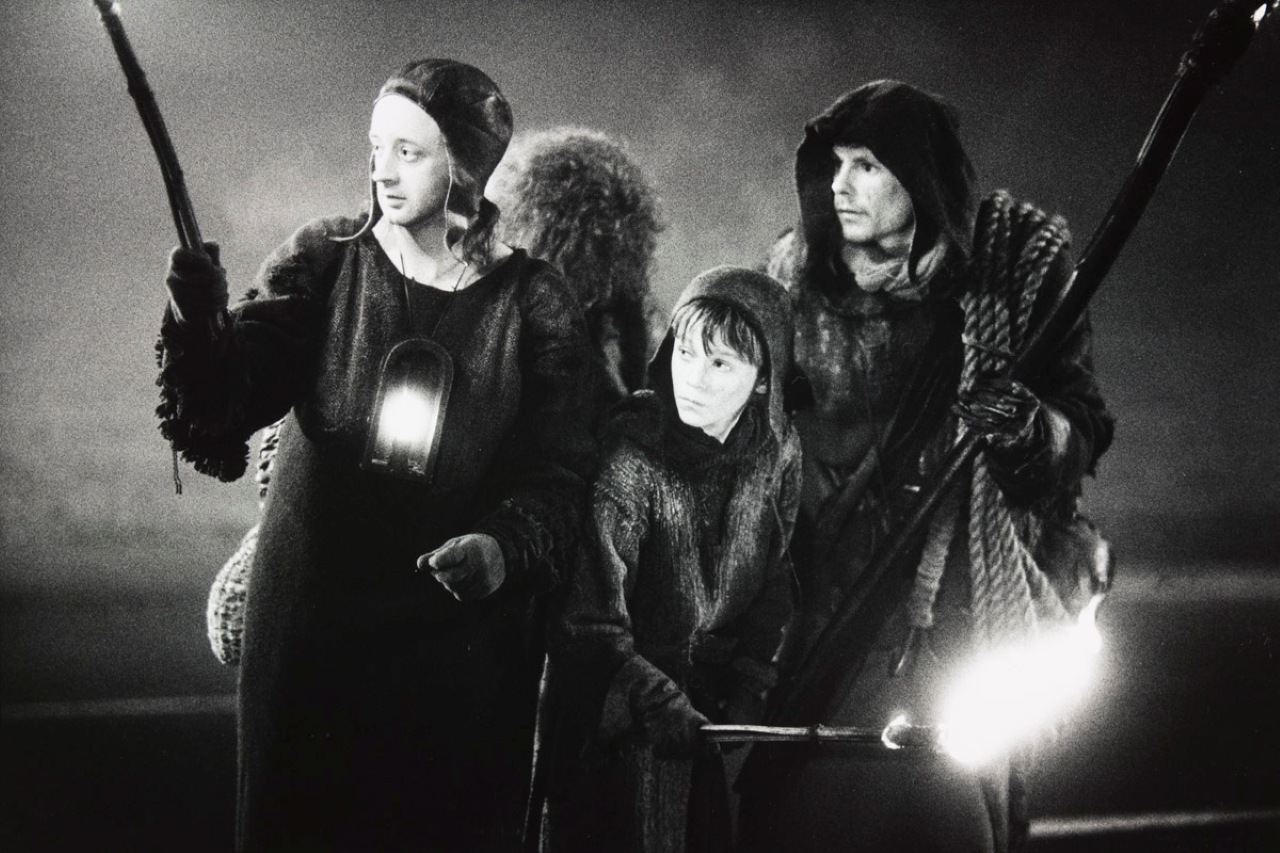
Nevertheless, The Navigator is still a Vincent Ward film and is something that moves on a subliminal level of painterly – in this case Baroque – tableaux. The images that Ward presents – visions of giant winged skeletons flying across gibbous moons – are arrestingly intense, almost hallucinatory in beauty. The scenes set in Cumbria have something of an Andrei Tarkovsky film circa Andrei Rublyev (1969) to them – there is an extraordinary richness of texture to the background where the past is seen as all ice and fire, shot in high contrast black-and-white, something that makes scenes like where the villagers drive a boat filled with plague infectees away by with oars into a vision that is unearthly.
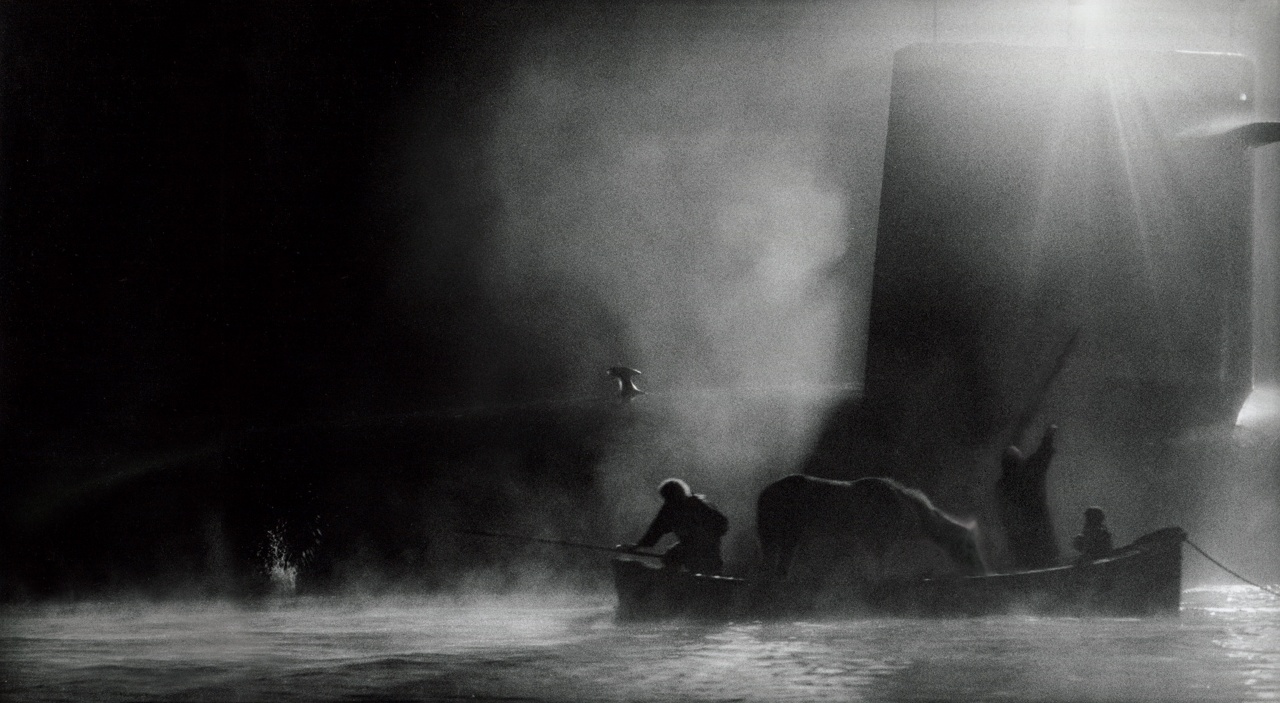
Most striking of all though are the confrontations with the modern world that take on a primal nightmare quality as seen through the eyes of the Mediaevals – a submarine (which rather improbably surfaces in Auckland Harbour) taken for a sea-monster and the images of the Mediaevals pitifully battering against it; trucks in a junkyard and cranes with grasping claws that take on the appearance of looming gargantua; Griffin confronting the multiple images of a personified Mediaeval Death reflected across the banks of a storefront window of tvs in an AIDS commercial; even the terrifying problems presented in simply crossing the street.
The film is utterly fascinating, like Vincent Ward has drawn one into something that has the clarity of a wide-awake dream. It is stunningly photographed in both colour and black-and-white – some of the compositions of light and darkness that the film offers make one cry out in surprise – like the still, eerily lit image of Hamish MacFarlane running down an empty street pursued by Marshall Napier on a horse. Ward also made a painstaking effort to have the cast speak with authentic Cumbrian accents. Davood Tabrizi’s score is on the pretentious side, managing to wind in everything from bagpipes, piccolos and Gregorian chants.
Trailer here